Content Culture
London · Established 2015 · Cultural sector

Institutions deserve better than a promotional video.

We make documentary film, photography and writing for museums, galleries, festivals and universities — work that treats an audience as intelligent and a subject as worth understanding.

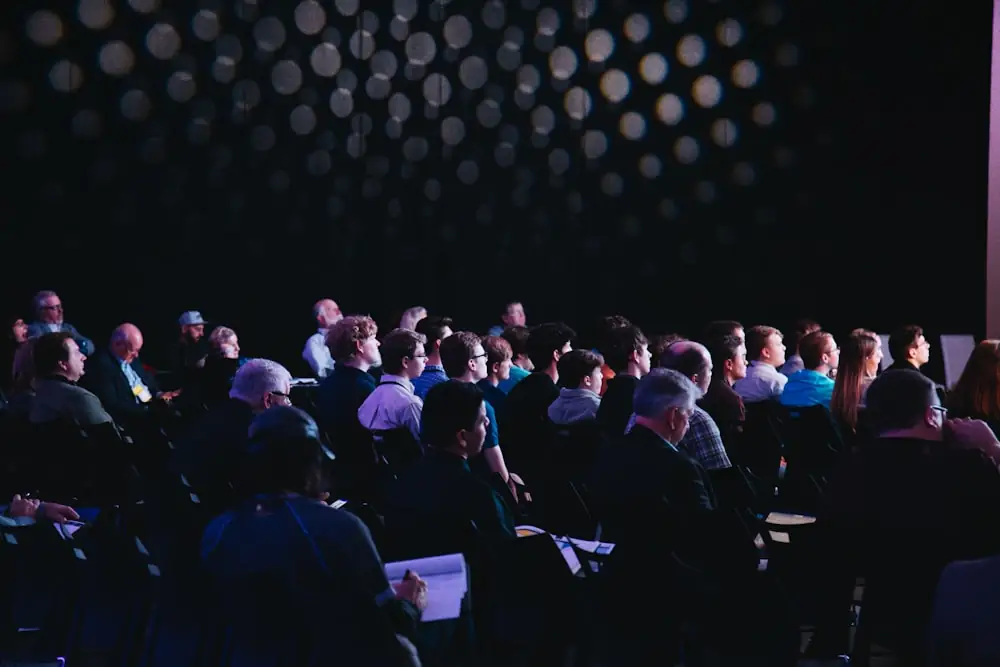
Audience seated before a large illuminated screen at a cultural event
Programme launch, documented for a national institution, 2026Photograph — Content Culture
I — Position

Against the promotional video.

There is a particular kind of film the cultural sector keeps commissioning. It runs to ninety seconds. It opens on a drone shot of the building. Somebody says the word "journey". A curator is filmed mid-sentence with their name spelled wrong on the lower third, and the whole thing is scored with library piano that suggests, gently, that you should feel something.

It is not a bad film exactly. It is simply a film that could be about any institution in Britain, which is another way of saying it is about none of them. It gets four hundred views, three of which are the director of communications checking it uploaded correctly.

We think this happens for an understandable reason. Cultural organisations are asked to justify themselves constantly — to funders, to boards, to local authorities, to a press that treats the arts as either elite or endangered. Under that pressure, the safest thing to produce is something that sounds like everyone else, because everyone else has evidently survived producing it.

But the institutions themselves are not generic at all. A regional museum holds forty thousand objects and one of them has a story that would genuinely stop a stranger in the street. A university archive has a conservator who has spent eleven years on a single manuscript and can explain why in a way that makes you want to see it. A festival has a lighting technician who knows exactly which two minutes of the year are worth filming.

Our practice is built on the belief that the specific thing is always more interesting than the general one, and that audiences can tell the difference immediately. We spend the first part of any commission looking for that specific thing, and we will happily tell a client that the story they wanted to tell is the third most interesting one available.

The rest is craft, and craft is not the difficult part. Filming carefully in a gallery, lighting an object without cooking it, writing a thousand words that a curator will not quietly rewrite — these are solvable problems. Finding the thing actually worth filming is the work.
"The specific thing is always more interesting than the general one."

Studio position, revised 2024
II — The practice

Six disciplines, one editorial standard.

Everything is made in-house by a studio of eleven. We do not sub-contract the thinking, and the person who researches a project is on set when it is filmed.

01

Documentary film

Short-form documentary about objects, people, processes and places. Researched properly, filmed patiently and cut without a voiceover telling the viewer how to feel.

  • Exhibition films
  • Curator & conservator portraits
  • Process documentation
  • Artist films
  • Legacy & evaluation films
  • Access-compliant versions
02

Photography

Installation views, object photography, event documentation and portraiture, made to archive standard as well as press standard, because most of it will outlive the campaign it was shot for.

  • Installation views
  • Object & collection
  • Private view coverage
  • Portraiture
  • Architectural & site
  • Archive-grade files
03

Editorial & interpretation

Writing that sits between the academic and the promotional: exhibition texts, interviews, essays and the interpretive copy that has to work for a specialist and a fourteen-year-old simultaneously.

  • Exhibition texts
  • Long-form interviews
  • Programme essays
  • Interpretation panels
  • Press materials
  • Plain English review
04

Oral history & archive

Recorded testimony captured to archival standard, transcribed, catalogued and delivered in a format your archive will still be able to open in twenty years.

  • Testimony recording
  • Transcription & indexing
  • Consent & rights management
  • Archival file delivery
  • Digitisation support
  • Access copies
05

Audience & evaluation

Content designed against a specific audience question, then measured honestly afterwards — including when the answer is that it did not work.

  • Audience research
  • Content strategy
  • Funder-ready evaluation
  • Reach & engagement analysis
  • Post-project reporting
  • Recommendations
06

Digital publication

Online exhibitions, digital catalogues and long-form web features, built to be readable, accessible and still working in five years without a maintenance contract.

  • Digital exhibitions
  • Online catalogues
  • Longform web features
  • WCAG 2.1 AA compliance
  • Static, low-maintenance builds
  • Handover documentation
0People in the studio
0Cultural commissions
0Years in practice
0Sector awards
IV — Sectors

Who we work with, and how it differs.

Museums & galleries

Objects first

The constraints are conservation, insurance and access. We work to your registrar's requirements, film out of hours where objects demand it, and deliver archive-grade files alongside the campaign versions. Roughly half our commissions come from this sector.

Festivals & performing arts

One chance, no retakes

Live work cannot be repeated for the camera. We plan around get-in and get-out, agree performer consent in advance, and staff to cover simultaneous stages rather than promising one crew can be everywhere.

Universities & research

Accuracy is the brief

Researchers are rightly wary of being simplified. Our editorial process includes a factual review stage where the subject can correct substance without redesigning the film, which is why academics agree to appear a second time.

Trusts, archives & heritage

Made to outlast the campaign

Heritage material has a longer life than a marketing cycle. Everything is delivered with catalogued metadata, documented rights and file formats chosen for longevity rather than convenience.

V — Rates

Fixed fees, published openly.

Excluding VAT. We quote a fixed fee against a written brief and we do not bill by the hour. Reduced rates apply to organisations with a turnover below £500,000 — ask, it is not a negotiation.

Documentation

Exhibition & event

£3,400 from

  • One or two days on site
  • Installation views and details
  • Event and private view coverage
  • Archive and press file sets
  • Delivered within 10 working days
  • Perpetual institutional licence
Enquire
Most commissioned

Documentary short

£11,000 from

  • Research and treatment stage
  • Two to four filming days
  • Original sound and grade
  • Access-compliant versions
  • Factual review with subjects
  • Social cutdowns included
  • Six to ten week schedule
Enquire
Partnership

Annual programme

£34,000 per year

  • Whole-season content planning
  • Documentation of every exhibition
  • Two documentary shorts
  • Editorial and interpretation support
  • Funder-ready evaluation
  • Named producer throughout
  • Quarterly review with your board
Enquire
Questions

Before commissioning.

Do you only work with cultural organisations?
Around nine tenths of our work is for museums, galleries, festivals, theatres, universities, archives and funded arts organisations. The remainder tends to be a commercial client with a genuine cultural programme — a foundation, a publisher, occasionally an architecture practice. We turn down work where the culture is decorative.
Can you work within public procurement rules?
Yes. We tender regularly, are familiar with framework processes, and hold the insurance levels most public bodies require — £10m public liability, £5m professional indemnity, £10m employers' liability. Policies, method statements, risk assessments and references are available on request without a delay.
How do you film safely in a gallery?
Usually out of hours, always in coordination with your registrar and security teams. Crews are briefed on object handling, we use battery-powered LED lighting with no heat load, and we agree exclusion distances in writing before the day. We have never had a conservation incident.
Who owns the resulting work?
You do. Every commission transfers a perpetual, worldwide institutional licence — including archive deposit, third-party press use and future exhibition reuse — on final payment. We ask only to show the work in our own portfolio, and you may decline.
Do you make access-compliant versions?
Always, and included as standard rather than as an extra line. Every film is delivered with burned-in and sidecar subtitles, a described version where appropriate, and a transcript. Digital publications are built to WCAG 2.1 AA and independently checked.
What if our budget is smaller than your published rates?
Tell us the number. We hold reduced rates for organisations with a turnover under £500,000 and we run two pro bono commissions a year, chosen in January. We would rather scope a smaller project honestly than deliver a compromised version of a larger one.
How far ahead should we commission?
Documentation can often be picked up within three weeks. Documentary work needs a longer runway — eight to twelve weeks from commission to delivery, more if the subject is seasonal. Annual partnerships are usually agreed the quarter before a season is announced.
Commission

Tell us what you are actually trying to say.

Not the format, not the running time — the thing you want an audience to understand. We reply within two working days, and if we are not the right studio we will say so and suggest who is.

Email[email protected]

Telephone+44 20 7946 0688

StudioSecond Floor, 14 Bedford Square,
London WC1B 3JA, United Kingdom

HoursMonday to Friday, 09:30–18:00 GMT

Please tell us your name.
Please check this address.
A few sentences, please.

Handled under our Privacy Policy. We reply within two working days. Enquiries are read by a producer, not a sales team.

Thank you. Your enquiry has reached the studio in Bedford Square and a producer will reply within two working days.